

- April 23, 2026
- By Karen Shih ’09
Navigating 23 miles of sidewalks on the University of Maryland’s hilly 1,350 acres can be an exercise in patience (and no small feat for your calves, either).
Now imagine you’re unfamiliar with campus, trying to trek from the Animal Sciences Courtyard up to the Architecture Building, maybe with a couple kids or a pup in tow, as one of 80,000 community members who visit on Maryland Day for plant giveaways and robot dog demos.
Enter the Maryland Day interactive map. With a few taps on your phone, you can get live bus info and walking directions, widgets to save favorite events and even a Testudo tracker with the mascot’s friendly face.
That’s just one of the many tools developed by the Campus Enterprise Geographic Information Systems (GIS) Team, which launched UMD’s interactive campus map in late 2013 and has since partnered across campus on popular projects like ghost tour and cherry blossom story maps. Users have visited the campus map nearly 5 million times since 2013, and the team will soon launch a hub where all of its creations will be aggregated and campus units can request data and mapping services.
Enterprise GIS Manager Taylor Keen ’04, M.S. ’06, oversees six staff members, two graduate assistants and several student interns, including Application Developer Will Definbaugh ’15, and Data and Project Coordinator Marie Overing. They spoke with Maryland Today about the campus map’s busiest day ever, how they made it easier to snag a selfie with Testudo and how their Maryland Day interactive map can help you find free ice cream.

The cherry blossom map is popular each spring as community members check out the 300 trees that bloom on campus each spring.
Keen: The public campus map is just the tip of the iceberg. There’s over 50 layers, showing everything from the tree inventory for the UMD Arboretum to café and Dining Services information and even all the makerspaces across campus. We get the most users at the beginning of the school year and Maryland Day, and had our single biggest spike in Fall 2021 when we returned to campus after COVID.
Overing: One of the cooler projects I’ve worked on is building the operations dashboard for snow removal. It shows all of the live vehicles cleaning the snow, along with updates from facilities and the operation center. In my role, I work on the back end, coordinating with groups across campus to build GIS solutions that work for them.
Definbaugh: In addition to application development, I also assist with integrating real-time data feeds into the campus web map. For example, users can find live bus routes. We have connections to regional transit APIs where I can read services from WMATA or The Bus (in Prince George’s County) and integrate them into our map.
Keen: In addition to the public-facing applications, we also maintain more than 100 services for administrative use, from mapping green roofs, rain gardens and sand filters for stormwater management, to showing all the underground utilities and interior spaces for Facilities Management. It may not seem glamorous, but it’s very important work critical to keeping the university functioning.
Definbaugh: There’s a lot that can be missed when you are just looking at data in a spreadsheet. You won’t be able to see the full picture. But if you see it on top of the landscape of the university basemap, you can get a better idea of how it all is interconnected.
Keen: Maryland Day is huge for us. Last year was the debut of our Testudo tracker, and people were incredibly excited. It was even mentioned in the local news. The mascot team said at their mascot summer camp that when they asked around, no other school was doing something like this, so this may be the first time a mascot’s real-time location has been tracked and integrated into a map application. Also, at least partially thanks to this highly publicized feature, we got almost a 50% increase in traffic that Maryland Day compared to the prior year.
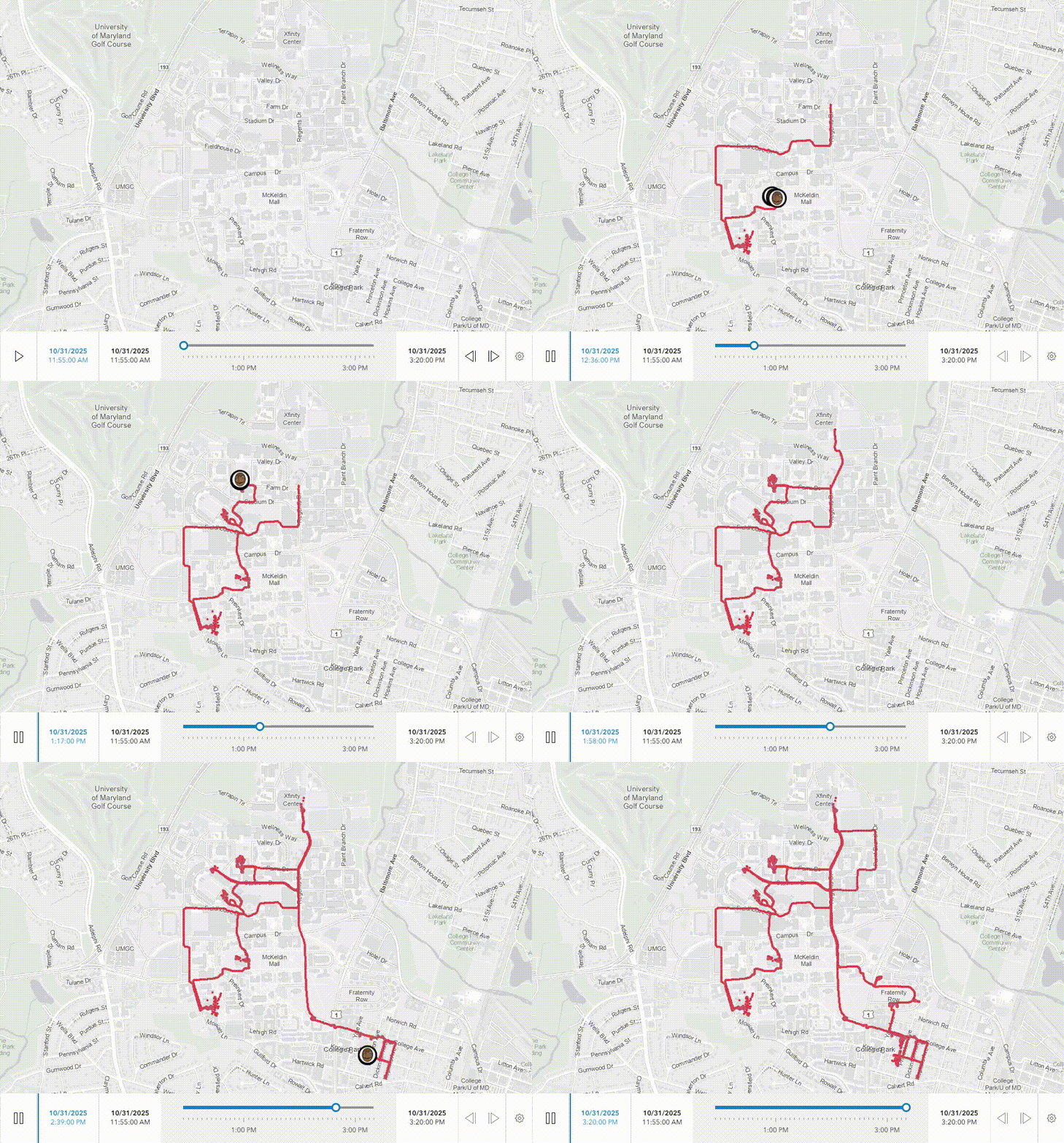
A time-lapse video of Testudo's movements around campus during Homecoming 2025.
Definbaugh: They loved it so much that they did it again for Homecoming and the first day of classes this past fall. When the Testudo team activates the tracker, you can see a little Testudo symbol moving around on the main UMD webmap.
Overing: We have a custom base map for Maryland Day, showing all the neighborhoods, tents, buildings being used, parking lots, construction and bus routes. On top of that is the event data, more than 400 events each year.
We help map the layout plan of all the events. Our interns create this mapbook with a grid of campus, showing exactly where all the tents, chairs and generators are, along with the size of the tents and number of chairs. Then the Maryland Day team prints out giant versions and laminates them so that staff can use them for set-up.
Definbaugh: You can use the map to find events close to you, discover photo opportunities like the Testudo statues or the M, food stalls and more. You can also do a keyword search, and some of the top search terms are “free” and “ice cream.” You can save events, see them on the map, and even make a route (using your device’s location) to get from place to place.
Keen: This year, we’ll sync up with the Shuttle-UM team to have live updates for the Maryland Day bus locations as well as the 104 bus that goes to the Metro station.
Definbaugh: One of our biggest challenges was in 2016, when Google changed their user location sharing settings, two days before Maryland Day, so we had to apply some hot fixes so it could work.
Keen: Looking toward the future, we now have ArcGIS Indoors, which we’re testing in certain campus buildings like McKeldin Library, where people could one day look up the call number of a book and get its precise location, or College Park City Hall, where FM’s main offices are located and you can find where HR staff is located, for example. One day, we’ll be able to use it in public applications to visualize interior spaces throughout campus so visitors can find rooms, events, and amenities indoors.

An interior view of the first floor of McKeldin Library.
This is part of a series that looks behind the scenes at “what it takes” to keep the University of Maryland humming and create a vibrant campus experience. Got an idea for a future installment? Email kshih@umd.edu.
Topics
Campus & CommunityUnits
Facilities Management