

- June 12, 2026
- By Jason P. Dinh
On a sunny May afternoon, a crew of seven students arrived at an empty campus parking lot behind Tawes Hall. They came equipped with a toolbox, traffic cones to set up a course and—for the worst-case scenario—a fire extinguisher. One student donned a racing suit, flipped the “Ready to Drive” switch and launched an electric race car down the track.
The vehicle is the product of a year’s work by the University of Maryland’s Terps Racing EV team, which is headed next week to the Formula SAE Electric competition at the Michigan International Speedway.
“We want to compete in and complete all the events,” said Terps Racing EV President Jeff Vedrin ’26, an aerospace engineering major. “The aim is to finish near the top.”
The team is the newest of the three within Terps Racing, a student club with more than 100 members that was founded in 1982. For its first few decades, the club had two teams: Terps Racing IC, which builds a race car with an internal combustion engine, and Terps Racing Baja, which designs a dune buggy-style off-road vehicle. Terps Racing EV entered the fold in 2021.
Working on an electric vehicle comes with unique challenges. In addition to the mechanical and aerodynamic hurdles that all three Terps Racing teams face, the EV team also must consider high voltage, battery heat, waterproofing and grounding. The students build the vehicle from scratch—including battery modules, aerodynamic components and data management system.
The complications were so significant that the team did not build an operational vehicle until 2024.
“I was the first driver ever to press the accelerator pedal on the car and make it move. That was crazy—to go from something that’s just on the computer that never worked in years prior, to being the person in the car with the fire suit on, with the helmet on, fully strapped in,” Vedrin recalled. “We were going 5 mph, but that feeling—oh my god. There’s nothing that can compare to that.”
Although many on the Terps Racing EV team are engineering students like him, others are majoring in computer science, math, physics, music, government and politics, and more. The diverse array of students allows the team to take on tasks from designing the car and manufacturing its components to designing uniforms and securing sponsors.
Corporate support comes from major companies, including Tesla, General Dynamics and Texas Instruments. Additionally, they receive funding from the A. James Clark School of Engineering and the Student Government Association.
Some team members have secured jobs with the team’s corporate sponsors. Others go on to work for automotive companies, including Lucid, Rivian, Ford, Stellantis and GM.
A select few even find employment with professional racing teams, such as Honda Motorsports. One of this year’s graduating team members, computer science major Ritwik Dobriyal ’26, will soon join General Motors Motorsports as a software engineer. His name even appears on the new Cadillac Formula 1 car.
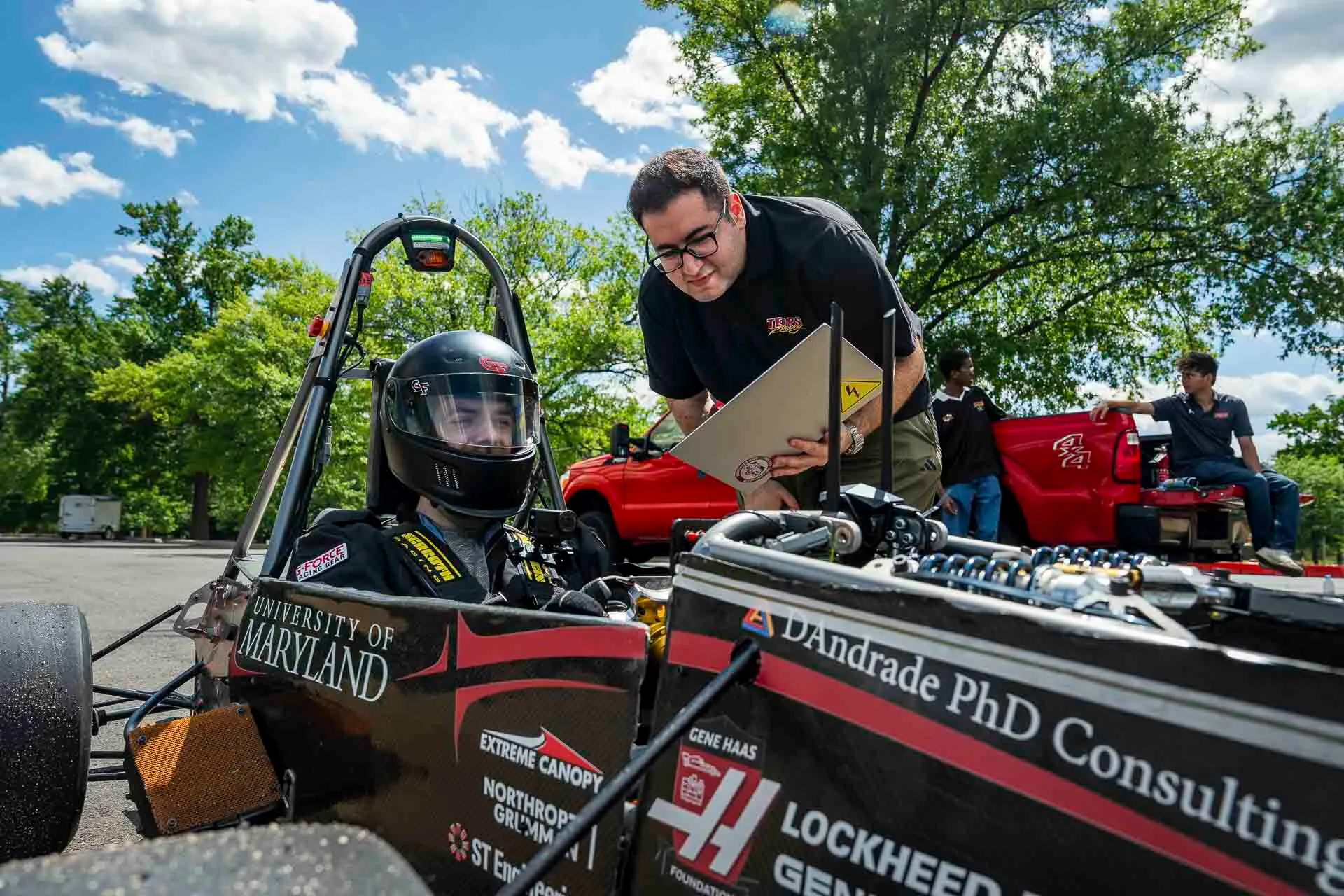
Computer science major Ali Niazi '26 troubleshoots issues using a custom-built data management dashboard.
On this day, the team was testing a new feature that would help the car accelerate across the 75-meter course as fast as possible. The buzz of the electric motor whizzed through the air on an otherwise quiet summer campus.
As the car raced around the makeshift course, the team’s high-voltage and software lead, computer science major Ali Niazi ’26, gazed at his computer screen. He and his teammates recently developed a new dashboard that can control the car remotely. It also displays real-time data on the vehicle’s speed, battery performance, brake temperature, tire health and more. This custom-built system—most of which was developed this year—is critical for fine-tuning the car to squeeze out every ounce of performance possible, said Niazi, who will soon begin a full-time job as a software development engineer at Tesla.
“We’re trying to abuse the car and see what breaks so it won’t during competition,” Niazi added. “If it does shut down, we know instantly what the issue was. In past years, we had to plug into our software manually and probe many points across the wiring harness with a multimeter until we figured out what was wrong. The dashboard helps us do rapid tuning, debugging and iteration all at the trackside."
Niazi hopes the new capabilities will help the team improve on its performance from last year. Despite hiccups with the vehicle’s waterproofing, it finished in the middle of the pack. This year’s car is much improved: It can accelerate from a standstill to 60 mph in under 3.5 seconds and top out at 76 mph.
The Formula SAE Electric competition, running June 16-20, includes a series of tests. The first unofficial challenge was simply registering. With only 100 available slots, there’s competition to get in.
“Last year, it was like when Adidas did Yeezy drops,” Vedrin said, laughing, describing how team members spammed the registration portal as if they were purchasing limited-edition sneakers. “But this year it’s different. It’s a raffle, so you just have to hope you get chosen.”
The competition itself involves a series of static and dynamic events. This includes a technical inspection, a cost presentation and a brake test, where drivers bring the car to 30 mph and then hit the brakes to lock up all four wheels.
There’s also an acceleration test, where they take their car from a standstill to the fastest speed possible within 75 meters, the skidpad, where they drive the car in figure eights, and a tilt test, where a platform boosts one side of the car laterally until it reaches 60 degrees to test rollover safety—with a team member inside.
Perhaps the toughest challenge is endurance, during which teams run their cars continuously for 44 kilometers. Some don’t make it the full distance.
“Endurance is the main thing we spec the entire car for because it puts the most strain on it,” Vedrin said.
To find the best driver for the event, Terps Racing EV’s most dedicated members race go-karts at United Karting in Hanover, Maryland, and the top two drivers earn the right to sit behind the wheel in Michigan for the endurance event.
“United Karting has real gas go-karts where you feel all the vibrations,” Vedrin said. “It’s really fun.”

Terps Racing EV team members come from across the university. The skills they learn have helped several find employment with professional racing teams, such as Honda Motorsports and General Motors Motorsports.
It’s that joy and camaraderie that Ethan Everitt ’26 appreciates most about the team. He joined after transferring to UMD from Binghamton University to find a community on campus.
Additionally, Everitt wanted to learn hardware skills to complement his computer science curriculum. Last year, as the team’s data acquisition co-lead, he integrated sensors into the car and engineered new ways to store and visualize data. Now, as the autonomous lead, he’s piloting camera systems that could one day allow the car to drive itself.
“It’s cool that I get to build a race car,” said Everitt, a Formula 1 fan, “but I also like that I’m able to put something real into the world that I can watch move—and to build something that I couldn’t on my own.”