

- June 08, 2026
- By Georgia Jiang
From facial recognition to large language models, recent AI breakthroughs came from systems built on mathematical approximations of cells called neurons that rapidly fire electrical signals across the brain.
But neurons only make up less than half of the human brain; now, a UMD-led project with $7.5 million in funding over five years from the U.S. Army Research Office will focus on unlocking the mysteries of the hidden half to provide models for next-generation AI systems.
This new Multidisciplinary University Research Initiative (MURI) will focus on star-shaped cells called astrocytes, which have remained largely unstudied by neuroscientists and AI researchers. The MURI is led by University of Maryland physics Professor Wolfgang Losert, chemistry and biochemistry Professor John Fourkas, electrical and computer engineering Assistant Professor Sahil Shah and Associate Professor Behtash Babadi; and Claremont Colleges Associate Professor of physics Sarah Marzen.
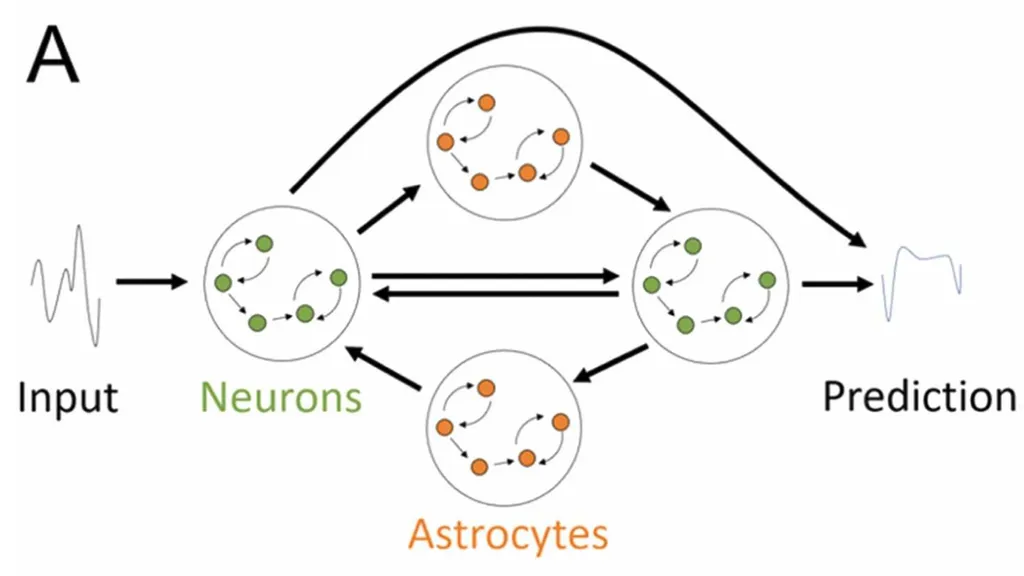
The researchers are pursuing what Losert calls “hybrid AI,” a new approach to machine learning that combines principles of biological computation with traditional computing. The teams will study astrocytes’ role in how the brain thinks—and determine whether integrating these biomechanisms with traditional computing hardware can produce AI that learns faster, adapts more reliably and stays resilient as real-world conditions around it change.
The idea is to build AI that thinks a little more like a human brain, Losert said, and astrocytes are the key to unlocking the next level of machine learning.
“Astrocytes, contrary to previous beliefs, are much more active participants in how the brain learns, remembers and adapts,” said Losert, who is also an MPower Professor with a joint appointment in the Institute for Physical Science and Technology. “Our goal is to take these biological insights and turn them into concrete algorithms that will outperform the AI systems we have currently.”
The MURI is a direct outcome of years of experimental study examining living astrocytes and artificial neural networks in the Losert lab, supported by the Air Force Office of Scientific Research biophysics program.
A first exploration of the role of astrocytes, published in April in the journal Neurocomputing, introduced a hybrid AI network containing both artificial neurons and artificial astrocytes wired to simulate their connectivity in the brain.
“One key difference between the two cell types is speed,” Losert explained. “Neurons communicate in milliseconds; astrocytes communicate over seconds. In the model, neurons handled rapid moment-to-moment processing while astrocytes integrated signals over longer time windows, kind of like a slow-burn memory running in parallel with the fast processing.”
When the team experimented with the proportions of astrocytes and neurons, they discovered that the fastest-learning networks had roughly twice as many astrocytes as neurons—a ratio that closely echoes estimates of the actual astrocyte-to-neuron ratio in the human brain. Losert believes this finding is an important clue toward building a more capable AI.
“Networks with both neurons and astrocytes learned significantly better than networks made of only one or the other,” he said. “They have to work together in order to be most effective.”
To push our understanding of astrocytes in computing further, Losert’s group explored how the slow oscillating waves in astrocytes could impact AI. In a paper published in the journal Physical Review Research in March, the team modeled brain cell communications to include these rhythms as rhythmic variations in link strengths in a neural network.
“We translated this into an algorithm called ‘rhythmic sharing,’ in which connections within an AI network continuously pulse and shift rather than staying fixed,” Losert said. “Training artificial intelligence to mimic the natural neural rhythms of the brain can absolutely revolutionize its ability to be an adaptive and intuitive tool.”
This rhythmic sharing algorithm wasn’t just a theoretical curiosity—it turned out to have a practical edge over conventional AI in real-world applications. In a paper published Wednesday in npj Unconventional Computing and led by computer science Ph.D. student Ian Whitehouse, the researchers found that the algorithm could detect changes in its environment faster than traditional AI. Tested on simulated data from a water treatment facility under cyberattack and from jet engines nearing failure, the algorithm detected warning signs earlier and more reliably than existing AI tools. Losert and Hoony Kang Ph.D. ’24 won the University of Maryland Invention of the Year award for this new algorithm.
“Systems trained to recognize normal conditions can fail silently when conditions gradually shift, sometimes without anyone noticing that anything has gone wrong,” Losert said. “But here, we found that this astrocyte-based algorithm is always listening and synchronizing. When something in the environment starts to shift, the disruption shows up in the rhythm before it shows up anywhere else.”
For Losert and the team, these findings are just the beginning of what astrocyte-based AI systems may be able to accomplish.
“From idea to impact takes years of collaboration, and the impacts can extend far beyond what we originally envisioned almost a decade ago,” he said. “We’ve demonstrated a performance advantage in detecting patterns in dynamic signals with our astrocyte-based models—and that has applications across all areas where dynamic signals exist, from health monitoring to communications and beyond.”
In the team's AI network, artificial neurons (green) and astrocytes (orange) are wired together to replicate the way the two cell types communicate in the human brain. (Image courtesy of Yang et al., Neurocomputing)
AI at Maryland
The University of Maryland is shaping the future of artificial intelligence by forging solutions to the world’s most pressing issues through collaborative research, training the leaders of an AI-infused workforce and applying AI to strengthen our economy and communities.
Read more about how UMD embraces AI’s potential for the public good—without losing sight of the human values that power it.
Learn how Forward: The University of Maryland Campaign for the Fearless will accelerate our momentum in addressing the grand challenges of our time and changing life and lives.