

- February 16, 2026
- By Maryland Today Staff
The University of Maryland's Grand Challenges Grants program is accelerating solutions to humanity’s most pressing issues in our communities and around the globe through education, research, scholarship, creative activities and service.
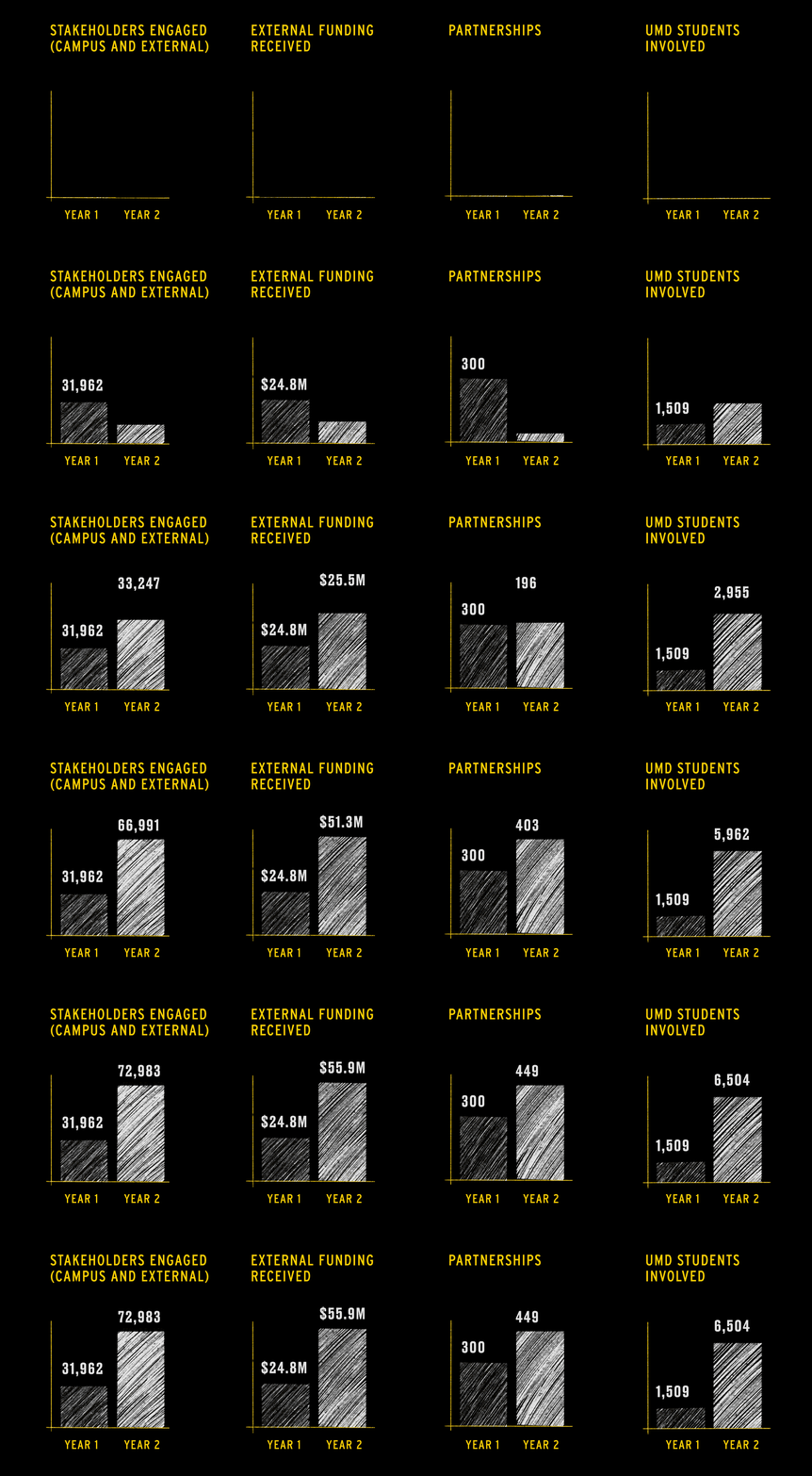
Three years ago, the university awarded $30 million to research teams and individual investigators tackling vital questions in areas ranging from global health to safe and efficient energy production to the promotion of economic growth and equality.
That investment has paid off in a surge of additional funding for the projects unlocked from external sources—nearly double the initial expenditure so far. It‘s paying off as well in life-enhancing results for our nation, state and world.
Now UMD is upping the ante on doing good for humanity with the Grand Challenges Grants Program 2.0. The university is now accepting proposals that will result in funding for up to 10 creative new institutional and team projects to address the most important societal challenges of our time.
Read on to learn more about the program’s impact so far.
Our Public Impact Is Growing

 Stephanie S. Cordle
 Stephanie S. Cordle
Impact Data
 Stephanie S. Cordle
Areas of Research
Protecting Our Planet
 John T. Consoli
As weather grows more volatile, the scientists of the Climate Resilience Network are working with state and federal agencies to protect Marylanders and their livelihoods. The team oversees Mesonet, a statewide weather tower network that warns of approaching storms and provides climate data to farmers, and the growing Hydronet sensor system that monitors coastal flooding.

Wildfires have doubled in frequency and intensity in the last 20 years. Now Terp engineers on the Observing Wildfires Through UAVs and Fire Imaging Technologies team are developing airborne tools to fight them. Their autonomous aerial vehicles (UAVs) will monitor spreading blazes to guide emergency crews evacuating people and extinguishing flames; the drones will even track windblown “firebrands” to pinpoint where new fires could erupt.

Plastic waste clogs our waterways and landfills, and manufacturing it is a major carbon emissions source. Biomolecular, computer and mechanical engineers with the Programmable Design of Sustainable, All-Natural Plastic Substitutes team are devising a system using artificial intelligence and robotic technologies to create and analyze sustainable, biodegradable substitutes for petroleum-based plastics.
Building Resilient Communities
 Stephanie S. Cordle
From Baltimore neighborhoods to Nepal and Tanzania, the members of the Global FEWture Alliance apply their multidisciplinary expertise to health and environmental challenges at the food-energy-water (FEW) nexus. Projects include harvesting rainwater for urban agriculture, using energy-efficient water treatment methods and converting landfill waste into clean energy—scalable solutions that aim to build healthier, more sustainable communities.

UMD experts in virology, veterinary medicine and airway biology with the Modeling the Evolution of Avian Influenza Viruses project have joined forces to protect farming communities and wild birds alike. They’re growing “organelles,” miniature intestines and tracheas that will provide unprecedented understanding of how birds—the source of many viral infections that plague humans—themselves get sick.

Sanitary sewer backups in basements are more than just a foul-smelling nuisance. Led by scholars of environmental health and urban studies and planning, UMD’s Water Emergency Team (WET) is documenting the dangerous bacteria associated with these overflows, which could harm people living in areas where deteriorating sewage infrastructure can’t keep up with intensifying rainfalls.
Strengthening Civic Foundations
 Stephanie S. Cordle
After conducting a comprehensive review of literacy instruction in all 24 Maryland public school districts, researchers with the Maryland Initiative for Literacy and Equity have worked with teachers, staff and principals around the state to implement their recommendations to help every student read and write proficiently.

The Maryland Democracy Initiative helps prepare people for a lifetime of civic participation. It has produced voter guides, supported voter registration drives and trained people on how to advocate for causes with policymakers and present testimony on bills. It also created K-12 teaching materials and professional development programs on civic literacy skills such as using credible sources to inform opinions and to discuss public issues.

A team of business graduate students supported by the Seizing Opportunities: Social Capital, Businesses, and Communities project provided valuable insight to Maryland state officials amid a shifting federal landscape. The group collaborated with the comptroller of Maryland on a joint report that quantified the impact of federal spending on the state as well as the effects of recent and projected budget cuts on its communities.
Advancing Technology for the Public Good
 David Andrews
Playing a musical instrument can benefit brain development, mental health and academic success, but in-person lessons aren’t easily available to everyone. The team behind Music Education for All Through Personalized AI and Digital Humanities is designing and refining software that will use artificial intelligence and computer vision to help students, teachers and parents evaluate progress in mastering musical skills.

The Fostering Inclusivity through Technology project is constructing a video-calling platform to make workplaces more inclusive and accessible for people with autism. Its team of language and cognitive scientists, engineers and experts in machine learning and human-computer interaction are investigating the precise causes and consequences of miscommunication between autistic and non-autistic people in hopes of promoting mutual understanding through tech.
People with disabilities face barriers in education, employment and health care when they can’t use or navigate websites, apps or online documents. The Maryland Initiative for Digital Accessibility brings together UMD experts to change that. Through workshops, research and courses, it’s actively working with industry, academia, and state and federal agencies to proactively build in accessibility when developing new tech.
Program Timeline


An Expanding Legacy of Solutions
The Grand Challenges Grants Program aspires to ignite projects that grow into transformative, long-term initiatives.
 John T. Consoli
Bioengineering doctoral student William Chen prepares to launch an underwater robot from a fishing boat on the Chesapeake Bay to search for oysters, part of a multidisciplinary project to use AI and robotics to boost the health of the watershed while reinvigorating Maryland's oyster industry.
 Adobe Stock
The Maryland Democracy Initiative, the Center for Educational Data Science and Innovation and the Artificial Intelligence Interdisciplinary Institute at Maryland (AIM) all began as bold ideas supported by the program. They have since secured new funding to broaden their reach, elevate their work and amplify their public impact for years to come.
—Jennifer King Rice
Senior Vice President and Provost
 John T. Consoli
Topics
ResearchUnits
Division of Research College of Computer, Mathematical, and Natural Sciences College of Behavioral and Social Sciences A. James Clark School of Engineering School of Public Health College of Agriculture and Natural Resources School of Architecture, Planning and Preservation Philip Merrill College of Journalism School of Public Policy Robert H. Smith School of Business College of Arts and Humanities College of Information Office of the Provost