
- March 06, 2026
- By Emily C. Nunez
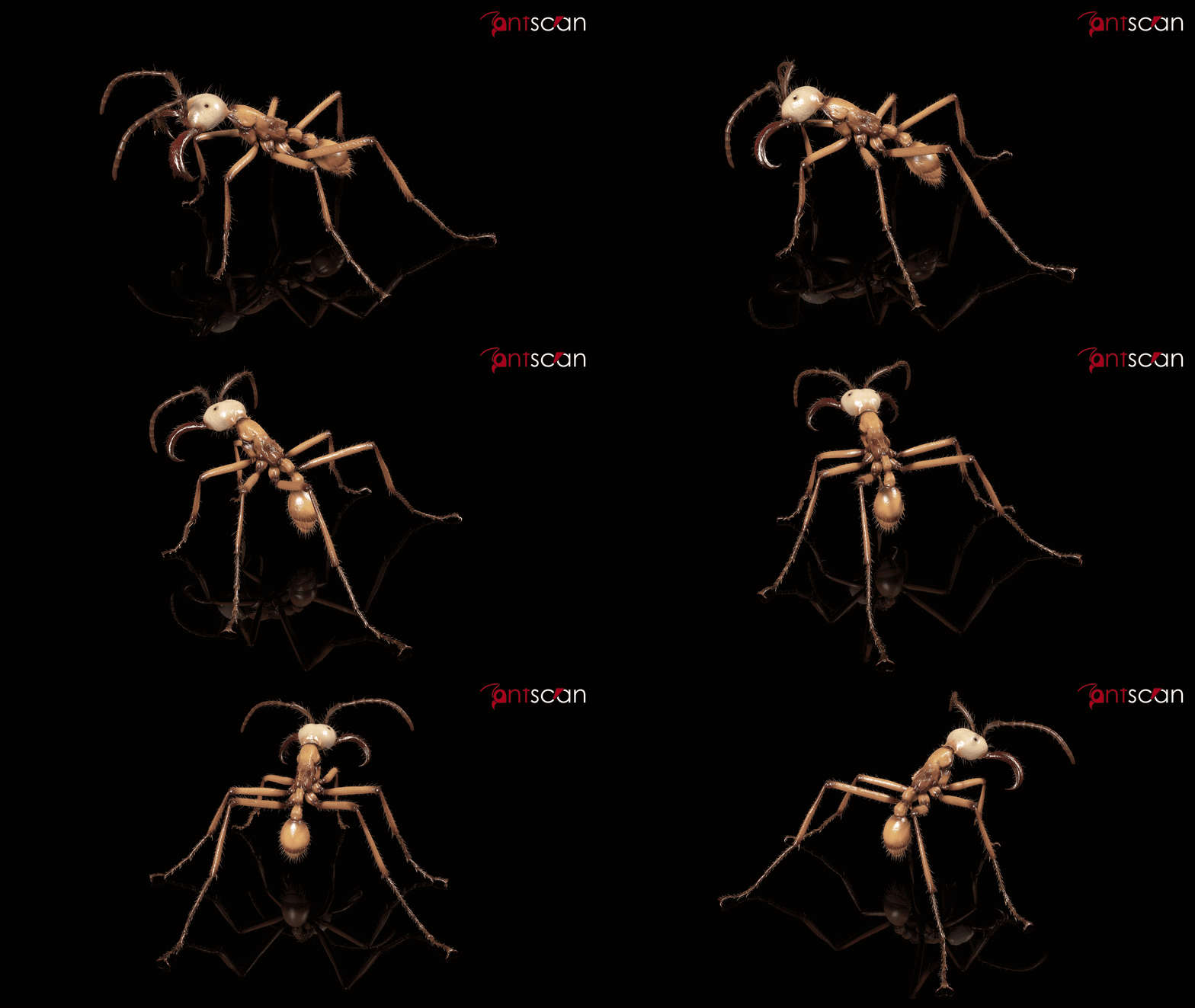
Using advanced imaging technologies and artificial intelligence (AI), a research team co-led by a University of Maryland entomologist devised a way to speed up the process of generating 3D images of ants, and now it has released a stunning digital gallery of the tiny critters viewed up-close and in unprecedented detail.
The multi-institutional team, including senior author Evan Economo, chair of the Department of Entomology, published a paper on their techniques on Thursday in the journal Nature Methods.
For more than a decade, his lab has been using micro-CT machines to scan insect specimens. The resulting X-ray images help researchers study the form and structure of insects—a subfield of entomology known as morphology—but it can take 10 hours to scan one specimen, said Economo, who holds the James B. Gahan and Margaret H. Gahan Professorship.
To speed up efforts, he and Thomas van de Kamp at the Karlsruhe Institute of Technology (KIT) in Germany led a team testing a high-tech workflow. It combined a synchrotron particle accelerator, X-ray scanning, robotics and AI to transform raw image files into high-resolution 3D models representing 800 different ant species.
“We’ve estimated that if we were to carry out this project with a lab-based CT scanner, it would take six years of continuous operation,” said Julian Katzke, the study’s first author and graduate of Economo’s lab at the Okinawa Institute of Science and Technology (OIST) in Japan. “With the setup at KIT, we scanned 2,000 specimens in a single week.”
Dubbed Antscan, this project could serve as a blueprint for future digitization efforts—not just for ants, but for a wide variety of species. The raw files for constructing 3D models are free for anyone to download, and a built-in viewer of every ant allows for easy access to the finished 3D images.
“The value of this study is not only about ants—it's much broader,” said Economo, who is now an adjunct professor at OIST in addition to his UMD role. “When specimens are digitized, we can build libraries of organisms that can streamline their use from scientific laboratories to classrooms to Hollywood studios.”
To build such an expansive digital library, the research team sourced ethanol-preserved ant specimens from partner institutions, museum collections and experts around the world. After the researchers sorted the specimens by species and caste, they brought them to KIT.
A synchrotron particle accelerator there produced a high-intensity X-ray beam to rapidly scan a huge number of specimens, and a robotic sample changer rotated and swapped out the specimens every 30 seconds. This enabled the creation of 2D image stacks that could then be used to construct 3D models.
While useful, the raw image files depicted ant specimens in contorted poses—a far cry from the lifelike models that researchers hoped to build. As a follow-up to Antscan, students in UMD Computer Science Associate Professor James Purtilo’s software engineering course are using AI to automate the process of “pose estimation,” enabling awkward ant poses to be transformed into natural ones that might be seen in the wild.
“This collaboration was a great opportunity for us,” Purtilo said. “A capstone is intended to challenge students to integrate skills, function as an effective team and demonstrate their ability to solve real problems. And this problem was a doozy.”
Given their high fidelity, the scans could someday even be used to train machine learning models to accurately detect ants in the field for observational studies of their behavior. Going forward, Economo plans to scan more specimens into the system while continuing to work with UMD computer science students to apply these AI techniques to new datasets.
AI at Maryland
The University of Maryland is shaping the future of artificial intelligence by forging solutions to the world’s most pressing issues through collaborative research, training the leaders of an AI-infused workforce and applying AI to strengthen our economy and communities.
Read more about how UMD embraces AI’s potential for the public good—without losing sight of the human values that power it.